 IITA – Bénin Campus, 08 BP 0932 Tri Postal, Cotonou – République du Bénin
 @Taat_Africa
 TAAT Africa
 @taatafrica
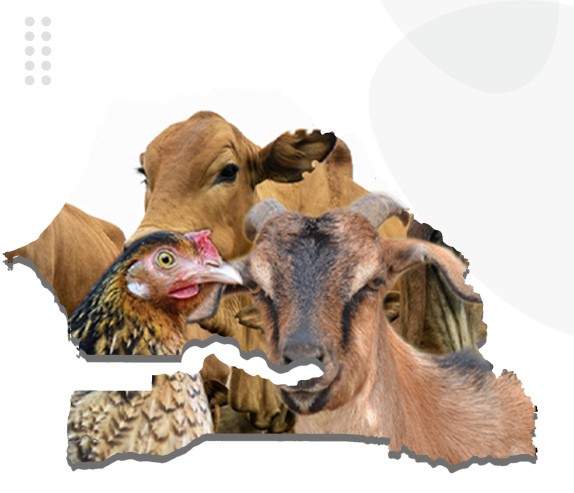
Senegal: TAAT targets food sovereignty through Livestock Innovations
Livestock plays a crucial role in the livelihoods of around 1.3 billion people in developing countries and contributes 30% of agricultural GDP in Africa.
With population growth, urbanisation, and rising incomes, the demand for animal products such as meat, milk, and eggs is increasing rapidly. Livestock farming not only supports family incomes and food security, but it also empowers women and provides cover in the event of crop failure.
The main difficulties encountered in livestock value chains are low productivity due to poor animal genetic potential and a lack of knowledge of good management practices.
In addition, limited access to nutrient-rich feed, pasture, microfinance, and climate change risk management strategies hampers the growth of these chains. Added to this is a high prevalence of disease due to insufficient involvement of veterinary services, low levels of public and private investment, inadequate infrastructure, and restricted markets.
To address these challenges, the African Development Bank in 2018 established the Technologies for African Agricultural Transformation (TAAT) Programme as part of its “Feed Africa” strategy to reverse the trend of declining food productivity in Africa by introducing modern food production technologies to 40 million farmers across Africa, focusing on supporting young people and women in low-income regions.
So far, TAAT has scaled up the dissemination of heat-tolerant wheat varieties, drought-tolerant maize, high-yielding rice, cassava, high-iron bean, sorghum, millet, orange-fleshed sweetpotato varieties and high-quality livestock breeds, and fingerlings to more than 12 million farmers, boosting crop production by an estimated 25 million tonnes.
With sights set on improving the productivity and profitability of small animal value chains through broadening the adoption of innovations in genetics, nutrition, health, production systems, policy, and marketing, TAAT, through its Livestock Compact led by the International Livestock Research Institute (ILRI), launched the programme’s Phase II intervention in Senegal recently.
Speaking during the Inception Launch and National Planning Workshop for the Livestock Compact in Dakar, Senegal, on February 7, 2025, Hon. Mabouba Diagne, the Senegalese Minister for Agriculture, Food Sovereignty, and Livestock, lauded the TAAT programme’s work plan for livestock development in the country.
In his keynote remarks, the minister, represented by Ms. Khady Kane, pledged his ministry’s support for achieving the compact’s objectives in Senegal.
“This project is timely because it is in line with the vision of the Ministry of Agriculture to work towards food sovereignty and security. It is all the more important because it addresses climate-related issues. And in the current context marked by the harmful effects of climate change, we can only welcome it,” the minister said.
In Senegal, the program adopts a multidimensional approach, including the development of climate-smart agricultural technologies and the dissemination of climate information services.
Dr. Nadine Worou, TAAT focal point in Senegal, thus highlighted the collaborative aspect of this initiative. ” This project will allow us to strengthen our collaborations with national institutions, but also our public and private partners ,” she said.
The programme aims to reach more than 10,000 agro-pastoralists through practical training and technology demonstrations. It also provides for capacity building of farmers’ organisations and seed companies in the production of dual-purpose cowpea seeds.
“ We are here for national goals and life goals. So we have to own this project and give our best so that there is a TAAT 3. The impact must be felt across the country,” stressed Dr Tunde Adegoke Amole, the TAAT Livestock Compact leader said.
“TAAT-2 represents a unique opportunity for Senegal to modernise its livestock sector while adapting it to climate challenges. Through its various components – from technical training to the dissemination of climate information – the program promises to sustainably transform the Senegalese agricultural landscape, thus contributing to the country’s food security and economic development,” Dr Amole added.
In Senegal, the compact will address livestock feeding, which is a major problem in the Sahel and leads to ecosystem degradation. The natural range lands that were largely used to feed herds are no longer sufficient to cope with the rapid increase in livestock (4-5%/year).
These problems also lead to increasing friction between communities. Agriculture must therefore take on an increasing role in the provision of feed for livestock. Moreover, fodder is not considered to represent a value in the value chain of the main crops (except perhaps for peanuts and cowpeas).
Consequently, crop residues of dry cereals (millet, sorghum), legumes and other crops are not yet sufficiently valued, sometimes even burned in the field before the next crop. The market for residues and other fodder resources remains very informal, with prices fluctuating during the year, uncertain quality, and a variable and geographically heterogeneous supply.

The TAAT livestock compact contribution in Senegal will focus on supporting the process of co-designing climate advice for assisting (agro)pastoralists in remote assistance for best practices in fodder crops management. This will be done by strengthening a community of practice made up of 9 institutions through training, workshops, policy dialogues, etc. on national fodder seed systems.
The compact will equally draft two fact sheets on proven climate-smart, productivity-enhancing agricultural technologies available to agro-pastoralists with a composition of climate-resistant feeds for small ruminants (groundnut tops and cakes, Maral alfa and alfalfa added to 55:14 cowpea)
Other planned activities include multi-channel dissemination of Climate Information Services (CIS) that will improve decision-making into fodder crops farming. Dissemination is carried out by JOKOLANTE and radio stations using the AICCRA platform for climate information services managed by the Ministry of Agriculture and Livestock.
TAAT will work to improve access to knowledge on a set of agronomic and climatic best practices (best seeds for animal feed, production itinerary, manure management) for dual-purpose cowpea technologies for at least 10,000 agropastoralists through field days at technology parks in Senegal.
The TAAT Livestock Compact will also build the capacity of farmers’ organizations and seed companies in improved techniques for producing certified dual-purpose cowpea seeds of climate-resilient varieties for large-scale forage production. The compact will train at least 10 agents in SME/community associations in Senegal on the design of grouped SIC services with feed composition, nutrient-enriched by-products, business plan, fodder management and marketing.
Through these initiatives, TAAT aspires to significantly improve productivity and resilience of Senegal’s agricultural sector, thereby contributing to the country’s food security and economic development.
Recent Stories

Related Stories
- Wheat in Africa: N’Djamena Declaration Charts Path Toward Food Security and Reduced Import Dependence
- TAAT targets resilient agropastoral systems through sustainable forage production in Senegal
- South Sudan: TAAT holds High-level Consultative Workshop on Food Systems Transformation
- Dakar 2 Summit: Development partners pledge $30 billion to boost food production in Africa
- Zimbabwe Charts a Bold Path for Food Systems Transformation through National Seed Roadmap