 IITA – Bénin Campus, 08 BP 0932 Tri Postal, Cotonou – République du Bénin
 @Taat_Africa
 TAAT Africa
 @taatafrica
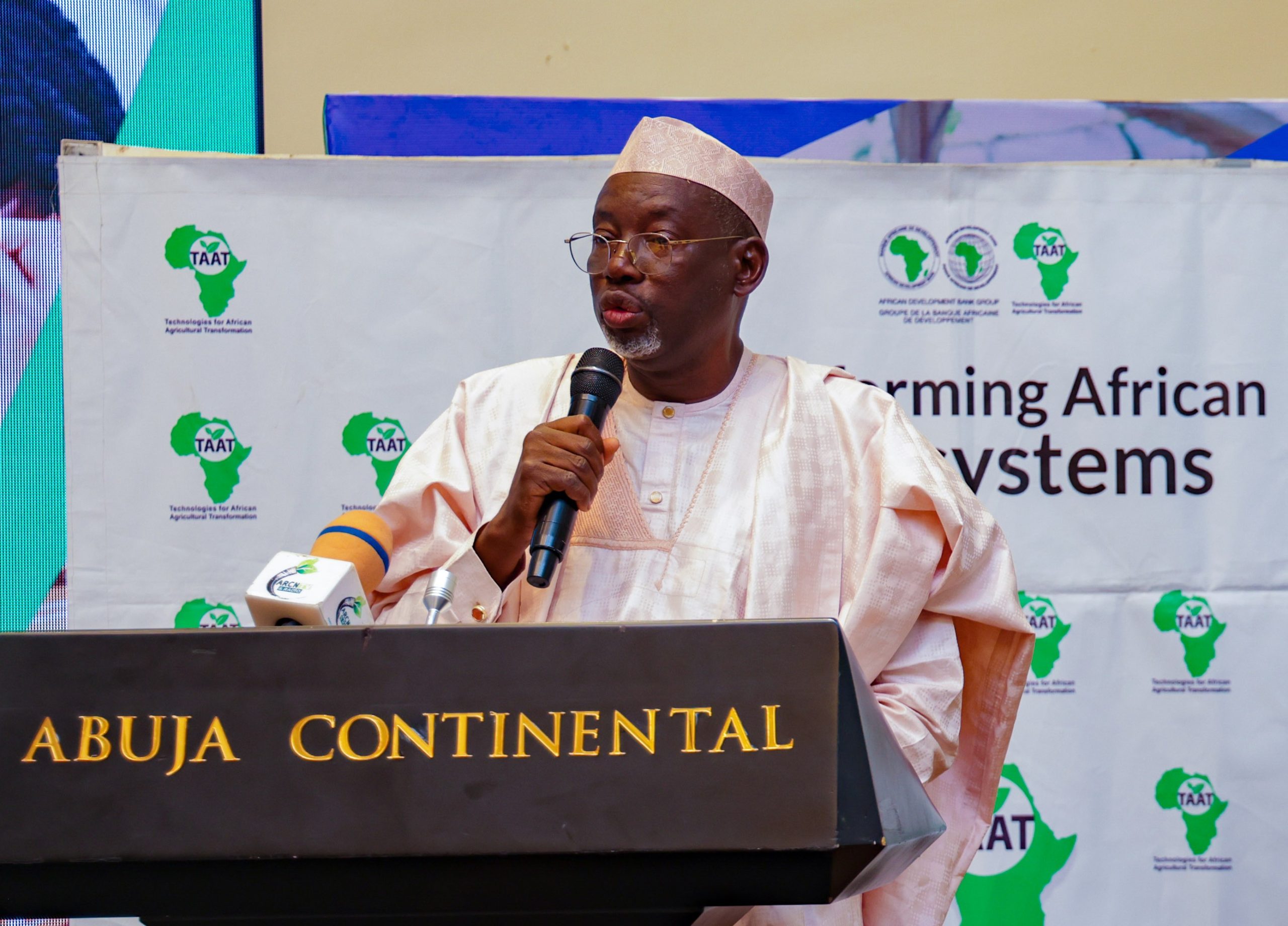
Jigawa State Government will be delighted to serve as an implementation platform for TAAT III
Jigawa State Government will be delighted to serve as an implementation platform for TAAT III
Keynote Address by His Excellency Malam Umar Namadi, FCA, Executive Governor of Jigawa State, Federal Republic of Nigeria, at the High-
Level TAAT Parallel Session 9th Africa Agriculture Science Week (AASW-9
Abuja, Nigeria | Tuesday 28th July 2026
Protocols
The Hon. Minister of Agriculture & Food Security,
Distinguished Senators and Members of the National Assembly,
The Officer in Charge of the Vice Presidency for Agriculture, Human and Social Development of the African Development Bank, Dr. Martin Fregene,
The Deputy Director General of the International Institute of Tropical Agriculture (IITA), Dr Tahirou Abdoulaye,
The Director of the CGIAR Scaling for Impact Programme, Dr Tim Krupnik,
Leaders of the Technologies for African Agricultural Transformation (TAAT) Programme,
Representatives of the African Development Bank, CGIAR Centres, FARA, National Agricultural Research and Extension Systems, Universities, Development Partners, Private-Sector Organisations, Farmer Associations,
Distinguished Delegates, Ladies and Gentlemen.
Let me start by commending FARA, the Agricultural Research Council of Nigeria, the African Development Bank’s Technologies for African Agricultural Transformation (TAAT) Initiative, Programme Partners and all convening
Institutions for bringing us together for AASW-9. This platform is vital for turning agricultural science into higher productivity, food security and better rural livelihoods across Nigeria and Africa.
- I am deeply honoured to join this High-Level TAAT Parallel Session under the theme, “Accelerating the Scaling of Agricultural Technologies and Innovations for Resilient, Inclusive and Sustainable Agrifood Systems in Africa.” The theme challenges us to move proven innovations from research and pilots into widespread use by farmers, while addressing rising food demand, climate pressures, nutrition challenges and the need for jobs across Africa. Africa’s agricultural opportunity lies in turning proven science into broad-based productivity, jobs, food security and shared prosperity. It speaks directly to competitiveness, economic diversification and sustainable food security.
- As a flagship of AfDB, TAAT is one of Africa’s most effective answers to ensuring that proven science does not remain in laboratories or pilot sites but reaches farmers widely. Its strength lies in linking validated technologies to strategic value chains and to the delivery systems that enable adoption. For me, TAAT’s central lesson is that agricultural transformation depends not only on technology, but also on collaboration, enabling policies, investment, extension, private-sector participation, finance, mechanisation, markets and accountable institutions.
- What, then, does Jigawa bring to the last mile of agricultural transformation? First, beyond our unmistakable commitment, I would say agriculture is the structure of Jigawa’s economy. Available statistics indicate that over 80% of the State’s projected 2025 GDP of about ₦3.2 trillion is
accounted for by agriculture, amounting to about ₦2.65 trillion, while the sector also supports the majority of households and provides livelihoods for millions of our people.
- Our objective is to turn this foundation into a stronger engine of food security, economic diversification, jobs, investment and shared prosperity, building on the State’s arable land, Fadama wetlands, water resources and livestock assets. That is why agriculture is central to our 12-point agenda, Comprehensive Development Framework and 2024–2030 Agriculture Policy, which aim to move Jigawa from high-potential subsistence farming to a productive, competitive, inclusive commercial agricultural hub.
- As part of our transformation strategy, we established the Jigawa Agricultural Transformation Agency (JATA) by Law to coordinate programmes, de-risk private investment, use evidence and geospatial data, and advance a productive, commercial and market-oriented agricultural system. This aligns with TAAT’s focus on productivity, proven technologies, strategic value chains, food security, climate resilience and inclusion. TAAT brings proven science, technologies and continental partnerships, while JATA connects them with farmers, finance, irrigation, mechanisation, markets and measurable results.
- To strengthen the role of science, evidence and innovation in Jigawa State’s agricultural transformation agenda, we recently launched the Wheat Value Chain Research Programme, supporting 10 PhD and MSc researchers in seed development, value-chain studies and irrigation efficiency, in partnership with leading universities and research institutes. The goal is to generate locally relevant technologies, improve wheat productivity and quality, strengthen research capacity
and ensure that findings are translated into practical recommendations for farmers and other stakeholders in the value chain.
- A related investment is the award of foreign postgraduate scholarships to over 80 academics from Jigawa State, including agronomists, breeders and agricultural engineers. This is building specialised expertise to strengthen local research, improve technology adaptation, enhance extension support, and sustain a knowledge pipeline for agricultural transformation.
- We have also effectively repositioned the Jigawa State Agricultural Research Institute through improved funding, equipped with state-of-the-art facilities and stronger capacity to generate farmer-focused solutions and work with credible national and international partners. Through this, we are linking research, policy and field delivery while promoting improved seed systems, soil fertility, irrigation, climate-smart agriculture, post-harvest management and agro-processing.
- Our transformation agenda is also directed at moving agriculture away from labour-intensive production towards systems that raise productivity, reduce drudgery and make mechanisation accessible and reliable. This led to the Jigawa Farm Mechanisation Service Company and one of Nigeria’s strongest state-led fleets, with tractors, harvesters, planters and other implements deployed through decentralised commercial centres. The result is less drudgery, expanded cultivation, new service enterprises and greater youth interest in agriculture.
- As we mechanise the system, we are also rehabilitating dams and irrigation facilities and expanding dry-season
production through solar-powered pumps and borehole-based schemes. This is enabling farmers in communities such as Lallashi, Auno, Samore and Gajarma to farm year-round, while renewable-energy irrigation, climate-smart practices, improved varieties and soil health solutions strengthen resilience and productivity.
- Another key aspect of our transformation drive is timely access to inputs and extension services. The 2026 Wet Season programme targets 90,000 active farmers with certified seeds, herbicides and subsidised fertiliser, supported by J-Agro advisory services, 1,185 motorcycles for extension agents, and digital farmer registries and e-verification to improve transparency, prevent diversion and widen participation in productive agriculture.
- Livestock development is also integral to our agricultural transformation agenda and now has a dedicated Ministry to drive a strategic plan. The Ministry has engaged with partners, including India’s National Dairy Development Board and Srinivasa Farms Limited, and is developing a joint venture to produce alfalfa-based feed for local use and export. Our priorities remain better feed, animal health, grazing management, veterinary services and peaceful farmer-herder relations.
- As we pursue agricultural transformation, Jigawa is not seeking to reinvent the wheel. We are deliberately leveraging existing knowledge, experience and proven field evidence through partnerships that help us adapt successful models to our own conditions. Across priority crops and value chains, we are working with AfricaRice, national and international research institutions, private partners, and the Federal Government to strengthen seed systems, expand dry-season
production, and connect farmers to processing, packaging, and export-ready markets.
- Beyond higher productivity, food security and profitability, these reforms are changing what agriculture means for ordinary people. We have disbursed over ₦7 billion to empower civil servants in agriculture, supported 18,000 youth farmers with machinery through partners such as WOFAN, with women making up 70% of beneficiaries, and advanced agribusiness financing through a StarAgri West Africa–Bank of Agriculture alliance. These efforts are expanding enterprise, incomes and inclusive livelihoods across our communities.
- As we make progress, we look to TAAT III for a results-oriented partnership model that works directly with implementation-ready States like Jigawa, helping them organise commodity-focused compacts, strengthen agricultural innovation systems, mobilise private-sector investment, expand digital agriculture, prioritise climate resilience and scale interventions that sustain inclusive agricultural transformation.
- On our part, Jigawa State Government will be delighted to serve as an implementation platform for TAAT III, offering its arable land, Fadama resources, irrigation and mechanisation systems, farmer networks, and established institutions to support viable farmer-centred agricultural transformation initiatives.
- In conclusion, our message is simple. Africa’s greatest agricultural opportunity lies in building the systems that turn proven technologies into productivity, jobs, food security and shared prosperity for farmers, communities and markets. Our transformation must be driven by science, delivered through
strong institutions and partnerships and measured by sustainable growth and better lives for our people.
- I sincerely thank FARA, AfDB’s Technologies for African Agricultural Transformation (TAAT), and all partners for convening this platform, and pray that our deliberations advance agriculture and shared prosperity across Nigeria and Africa.
- Thank you all.
Recent Stories
Related Stories
- Gov Namadi Hails TAAT as a Continental Model for Scaling Innovation, Positions Jigawa as a Launchpad for TAAT Phase III
- Leaders acknowledge TAAT as a bold initiative to achieve a hunger-free world
- Jigawa State Positions Itself as a Strategic Implementation Partner for TAAT III
- TAAT harps on Ag-Innovation Systems to Accelerate Africa’s Food System Transformation as Agriculture Science Week Ends
- TAAT Demonstrates that Food Systems Transformation and Sustainability Can Go Hand in Hand