
 IITA – Bénin Campus, 08 BP 0932 Tri Postal, Cotonou – République du Bénin
 @Taat_Africa
 TAAT Africa
 @taatafrica

TAAT supports Productivity Design for Nigeria’s SAPZ Phase II Tranche II
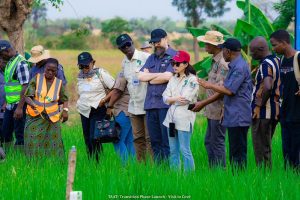
Following the successful design of the Agro-Industrial Processing Zones (SAPZ) Phase II Tranche I across ten Nigerian states in 2024/2025, a joint mission by the Technologies for African Agricultural Transformation (TAAT) programme and the African Development Bank (AfDB) recently concluded a high-level pre-appraisal mission aimed at preparing SAPZ Phase II Tranche II.
Conducted from 23 February to 13 March 2026, the mission covered 11 Nigerian states to establish the technical and operational foundations for the next phase of implementation.
The mission reinforced TAAT’s central role in supporting Component 2 of the SAPZ programme, which focuses on agricultural production and productivity enhancement.
Recognising that agro-industrial hubs require a stable supply of quality raw materials, the team identified high-impact technology interventions across key value chains, including rice, cassava, cocoa, oil palm, maize, and livestock.
Based on technical assessments, the expansion strategically targets states across Nigeria’s diverse agroecological zones.

Northern states such as Jigawa, Taraba, and Nasarawa were identified as priority hubs for rice and maize production through the promotion of climate-resilient seed varieties and irrigation systems.
In the South-East and South-South regions, states including Abia, Ebonyi, Akwa Ibom, and Bayelsa will focus on scaling rice and cassava production while rehabilitating ageing cocoa and oil palm plantations.
The mission also ensured that proposed interventions are adapted to the ecological and market realities of each participating state.
Through extensive consultations with government authorities, community leaders, and private sector actors, the initiative strengthened local ownership while identifying strategic partnerships capable of accelerating implementation.
A major highlight of the mission was the integration of TAAT’s climate-smart technologies into the project design.
These include improved rice varieties and GEM parboiling technology to improve grain quality, Semi-Autotrophic Hydroponics (SAH) systems for rapid multiplication of disease-free cassava stems, and digital tools such as Akilimo and the TAAT e-catalog to support precision agriculture and farmer advisory services.
The mission further explored opportunities for co-financing and private sector investment to ensure a market-driven approach from the outset. Anchor investors are expected to play a key role in managing processing facilities and strengthening agricultural value chains within the SAPZ framework.

According to Dr Ernest Asiedu, the TAAT Regional Country Engagement Officer for West Africa, “By embedding TAAT’s technical expertise directly into the design phase of the SAPZ programme, the initiative demonstrates how agricultural innovation can be effectively integrated into large-scale development investments.”
“As the project advances toward formal appraisal, the programme is expected to strengthen productivity, improve rural livelihoods, and transform Nigeria’s agricultural landscape into competitive agro-industrial growth zones,” He also added.
Recent Stories


Related Stories
- Liberia Hosts Seed Sector Investment Roundtable to Unlock Agricultural Transformation
- TAAT facilitates seed roadmap to boost agricultural productivity in Benin
- Seed System: TAAT rallies Stakeholders for a Seed Roadmap for Benin
- BENIN: TAAT and partners convene stakeholders for a seed roadmap
- TAAT and the imperatives of food systems transformation in Benin