 IITA – Bénin Campus, 08 BP 0932 Tri Postal, Cotonou – République du Bénin

 @Taat_Africa
 TAAT Africa
 @taatafrica

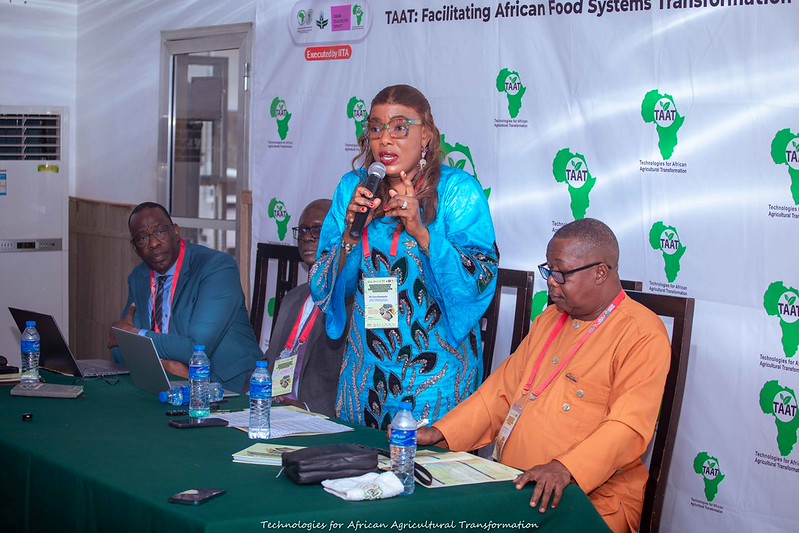
Before the Harvest, the Seed: TAAT and Partners Train Seed Champions in Sierra Leone
As Feed Salone races toward 2028, a four-day training aims to fix the first link in the food chain
Picture a farmer in the rainy season, kneeling at the edge of a freshly cleared field with a bag of seed saved from last year’s harvest. It has been stored during the dry months, with no guarantee of purity and no certificate stating what is inside. She plants it anyway, because there is little else to plant.
Across Sierra Leone, this scene is common. It is also the quiet reason why good varieties developed by scientists too often fail to turn into good harvests.
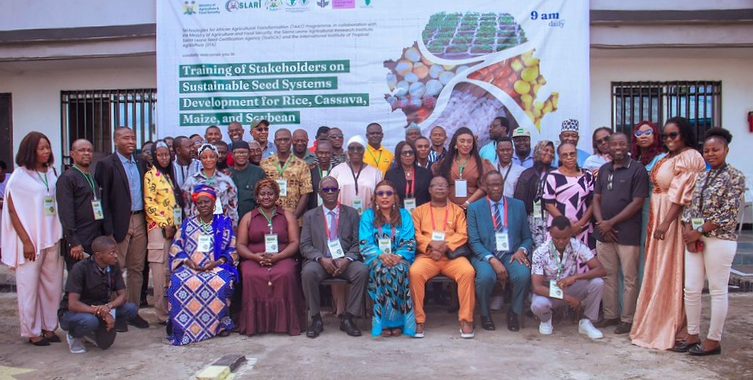
From 26 to 29 October, about 60 people who can change that will meet in Bo: seed certifiers, researchers, private seed companies, community seed enterprises, seed growers, agro-dealers, extension officers and university staff. Their job for four days is to learn how to build a seed system that works, then plan how to do it.
The training is organised by the Technologies for African Agricultural Transformation (TAAT) Programme in collaboration with the CGIAR Scaling for Impact Programme, the International Institute of Tropical Agriculture (IITA), the Sierra Leone Agricultural Research Institute (SLARI) and the Sierra Leone Seed Certification Agency (SLeSCA).
The seed gap
Sierra Leone is not short of ambition. The Feed Salone Strategy (2023-2028) aims to move agriculture from largely subsistence production to a productive, market-oriented sector and to reduce reliance on imported food. Policies on seed and fertiliser are in place.
But an assessment undertaken with support from TAAT found the formal seed system struggling to deliver. Breeder, foundation and certified seed are in short supply. Quality assurance and certification are weak. Private seed enterprises are few and often short on business skills. And the links between researchers, seed producers, regulators, agro-dealers and farmers are thin.
When quality seed is unavailable, farmers fall back on recycled, poorly stored or uncertified planting material. Varietal purity drops, risk rises, and yields and profits suffer. In a changing climate, with drought, pests, disease and shifting rains, the cost of that gap grows.
Proof that seed pays
There is evidence that investing here works. TAAT-supported interventions in Sierra Leone multiplied breeder and foundation rice seed, distributed certified rice and maize seed through emergency support, strengthened cassava seed production using semi-autotrophic hydroponics technology, and helped improve seed certification and quality assurance. Supported farmers reported yield increases of about 25-30%.
The catch, according to the training’s rationale, is that such gains remain fragile. Too often they came through individual projects rather than a coordinated, sustainable, market-driven national system.
From projects to a system
The Sierra Leone Seed System Roadmap is meant to change that by pulling earlier investments into a single national approach. A roadmap, though, needs people to carry it out. That is what the Bo training is for.
Dr Isata Kamanda, Deputy Minister of Agriculture and Food Security, Sierra Leone, declared at the opening ceremony that “the Feed Salone Strategy requires a productive and resilient agricultural sector, and that begins with farmers having access to quality seed. Strengthening our seed system will support increased domestic food production, create opportunities for agricultural enterprises and help reduce our dependence on imported food.”
The Head of the TAAT Clearinghouse, Dr Solomon Gizaw, in his opening remarks, stated that “a sustainable seed system is much more than a supply of improved varieties. It requires strong institutions, reliable quality assurance, capable seed enterprises, and effective connections among research, markets, and farmers. TAAT is working with its partners to strengthen these links so that proven agricultural technologies can reach more farmers and deliver lasting results.”
To Dr Conteh Kamara, the Director-General, SLARI,“agricultural research can transform productivity only when its results reach farmers in forms they can access and use. Stronger collaboration between researchers, seed producers, regulators and private enterprises will be critical to ensuring that improved and climate-resilient varieties contribute to Sierra Leone’s agricultural transformation.”
The Executive Director of SLeSCA, Dr Robert Chakanda, in his welcome remarks, underlined the importance of quality assurance in a seed system. “Quality assurance is essential to building trust in the seed sector. By strengthening inspection, testing, certification and compliance with national standards, we can protect farmers, improve confidence in seed markets and support responsible seed businesses,” Dr Chikanda said.
Over four days, participants will work through the whole chain. Policy and regulation. Climate-smart varieties of rice, cassava, maize and soybean. Seed multiplication and field management. Inspection, sampling, laboratory testing and certification. Drying, cleaning, grading, packaging and storage. Seed business planning, marketing, demand forecasting, contract production and access to finance. And fertiliser: how to use it well, store it safely and navigate regulation.
The format is hands-on: group work, case studies, demonstrations, and role-plays in which participants act out certification, inspection, and business scenarios. Where facilities allow, they will visit seed fields, processing plants, warehouses and testing laboratories. They will also meet digital tools such as e-registration and seed traceability, which can make certification more transparent and markets easier to reach.
Leaving with a plan
The training ends with work, not speeches. Each participating institution will draft an action plan tied to the roadmap, naming priority activities, who is responsible, timelines and the resources needed.
The organisers argue that a productive agricultural sector cannot be sustained without a reliable, market-driven seed system. If the plan holds, the payoff reaches well beyond seed: higher and steadier yields, stronger farmer incomes, more private investment and jobs, greater climate resilience and a firmer base for national food and nutrition security.
For the farmer at the edge of the field, it could mean opening a bag of seed and knowing exactly what she is planting.
Recent Stories
Related Stories
- Seeds of a Self-Reliant Sierra Leone: Inside the Four-Day Push to Fix the Country’s Seed System
- Seeing Is Believing: Nigeria’s Seed Industry Heads to the Field to Test Africa’s Next Generation of Crops
- From Breeders to Farmers: TAAT Brings Seed Technologies Closer to the Market in Nigeria
- From Research to Farmers’ Fields: TAAT and AFSTA Mobilise Africa’s Seed Industry to Scale Improved Crop Varieties
- Zimbabwe Hosts National Seed Summit to Accelerate Food Systems Transformation