 IITA – Bénin Campus, 08 BP 0932 Tri Postal, Cotonou – République du Bénin
 @Taat_Africa
 TAAT Africa
 @taatafrica
TAAT engages Agro-Processors to Boost Soybean Oil Production in Ghana
The Technologies for African Agricultural Transformation (TAAT) programme, in collaboration with its partners, continues its efforts to strengthen agricultural value chains across Africa.
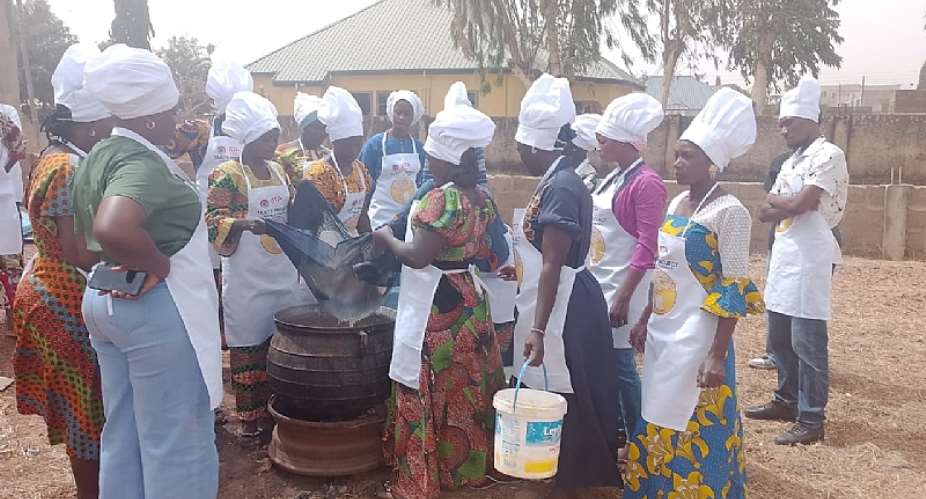
In Ghana, a training session was organised for 30 small-scale agro-processors on improved soybean oil extraction techniques to increase productivity, enhance product quality, and expand market opportunities.
The training was held on 21 February 2025 under the TAAT Soybean Compact through the Council for Scientific and Industrial Research, via its Savanna Agricultural Research Institute (CSIR-SARI), with funding from the African Development Bank.
This activity forms part of a broader set of actions aimed at strengthening the soybean value chain in northern Ghana by improving the efficiency of local processing methods, enhancing product quality, and facilitating access to markets.
Participants included small-scale processing enterprises, producer organisations, and young entrepreneurs engaged in agribusiness in the Northern Region of the country. The initiative was coordinated with the International Institute of Tropical Agriculture (IITA), which leads the TAAT Soybean Compact.
During the training, participants took part in a series of practical demonstrations on modern soybean oil extraction techniques.
Researchers from CSIR-SARI presented the different stages of the process, from cleaning and sorting the seeds to roasting, grinding, pressing, and oil clarification. Trainers also emphasised proper storage and handling practices to preserve the quality of the final product.
According to Charles Nelimor, TAAT Soybean Compact Coordinator at CSIR-SARI, many small-scale processors continue to rely on traditional processing methods, which often result in low oil yields and inconsistent product quality.
“These challenges reduce profitability and limit processors’ access to more lucrative markets. The improved methods presented during this training help address these gaps by reducing losses and improving processing efficiency,” he explained.
Participants were also sensitised to sanitary best practices, quality control mechanisms, and basic maintenance of processing equipment. These elements are increasingly essential for processors seeking to access urban markets or supply institutions and organised buyers, where quality and food safety requirements are becoming more stringent.
Beyond the technical aspects, the initiative also aims to strengthen local agribusiness development. By improving processing capacity at the community level, programme stakeholders hope to promote job creation and reduce Ghana’s dependence on imported edible oils.
Speaking during the training, Desmond Sunday Adogoba, a socio-economics expert at CSIR-SARI, highlighted the strategic importance of soybean in northern Ghana.
“Soybean is a strategic crop because of its adaptability to the savannah ecology and its role as a source of income, nutrition, and livestock feed,” he said.
Although soybean production has increased in recent years, processing and value addition remain limited, preventing many farmers and processors from fully benefiting from the economic potential of the crop. Improving processing techniques could help change this dynamic.
Higher-quality soybean oil can be sold both in domestic markets and in commercial supply chains. In addition, soybean cake produced during oil extraction can be used as livestock feed, providing processors with an additional source of income.
Participants were also encouraged to explore collective approaches such as cooperatives to improve access to processing equipment, financing, and markets. Limited access to machinery and capital remains a major challenge for many small-scale processors.
Collaboration among actors can help reduce production costs and strengthen links with buyers.
Participants expressed satisfaction with the practical and scientific nature of the training. Several noted that access to this type of technical knowledge remains rare in rural communities and that the skills acquired will enable them to improve product quality, reduce losses, and strengthen consumer confidence, thereby contributing to the sustainable development of the soybean value chain.
Such training initiatives accelerate the adoption of proven agricultural technologies across Africa. By strengthening the capacities of farmers, processors, and agribusiness entrepreneurs, TAAT contributes to improving productivity, incomes, and food security in Ghana and across the continent.
Recent Stories
Related Stories
- Kenya: TAAT holds ToT Workshop on Soybean Agronomy, Seed Production and Entrepreneurship
- TAAT Showcases Agricultural Innovations at the Kilimo Biashara Expo 2026
- Benin: TAAT hosts Green Field Day, Showcases Wheat Potential
- Uganda: TAAT showcases improved and resilient soybean varieties
- From Training to Transformation: How TAAT is Driving Aquaculture Innovation in the DRC