 IITA – Bénin Campus, 08 BP 0932 Tri Postal, Cotonou – République du Bénin
 @Taat_Africa
 TAAT Africa
 @taatafrica
Central African Republic: TAAT sets Sights on the Production of 20 million Certified Cassava Cuttings by 2027
Cassava is central to food security and rural livelihoods in the Central African Republic (CAR). Yet the country’s cassava seed sector remains largely informal, relying on farmer-to-farmer exchanges of planting material. This limits access to improved varieties, weakens quality assurance and traceability, and can contribute to the spread of diseases through unhealthy cuttings.
These constraints affect more than seed supply. They limit productivity, reduce farmers’ capacity to invest in cassava as a business, and restrict the development of a sustainable market for quality planting material. Strengthening the formal seed system is therefore essential to support higher yields, more resilient production and a stronger cassava value chain.
To help address this challenge, Technologies for African Agricultural Transformation (TAAT) is supporting a Training of Trainers component within a broader regional capacity-building initiative on formal cassava seed systems.
The initiative will bring together national regulators, researchers, seed producers, and lead farmers to strengthen the technical, institutional and business foundations of the sector.
The regional training will involve senior representatives from the Central African Republic, Guinea and Guinea-Bissau.
Fourteen institutional participants are expected to strengthen their knowledge of seed laws and regulations, variety registration and release, certification procedures, quality assurance, field inspection and seed sector governance.
The sessions will draw on regional experience, including expertise from the Democratic Republic of Congo’s SENASEM system and technical contributions from the TAAT Cassava Compact led by the International Institute of Tropical Agriculture (IITA).
Alongside this institutional component, TAAT will support the training of 100 seed producers, lead farmers and emerging seed enterprises in CAR. Participants will focus on practical skills for cassava seed multiplication, rapid multiplication methods, disease identification and management, good agricultural practices, quality assurance and business planning.
The training will also introduce digital tools for seed registration, traceability and certification, including the Seed Tracker platform. By combining classroom learning, practical demonstrations, field inspections, case studies and digital simulations, the programme will help participants translate knowledge into action within their respective institutions, enterprises and farming communities.
For seed producers and lead farmers, the expected value of the training goes beyond technical production. Participants will also strengthen their capacity to manage seed enterprises, develop business plans, engage in contract farming and market quality cassava planting material.
This agribusiness dimension is critical to creating a seed system that can operate sustainably and respond to farmer demand.
A key feature of the initiative is its planned cascade effect. The 100 trained producers and lead farmers are expected to share knowledge and improved practices with approximately 2,000 farmers and seed enterprises nationwide.
This approach can accelerate the adoption of clean, disease-resistant and high-yielding cassava varieties while expanding access to reliable planting material. In the longer term, the programme aims to contribute to the production of at least 20 million certified cassava cuttings by the end of 2027.
These are expected outcomes, not results already achieved. If realised, they could support increased cassava root production, improved food security and greater private-sector participation in the seed industry.
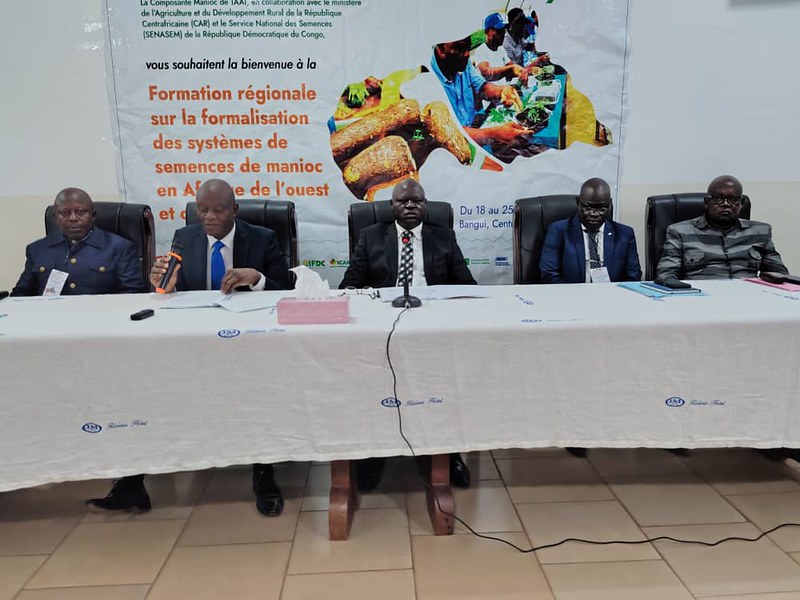
Speaking at the opening ceremony of the regional ToT in Bangui, Dr Adebayo Abass, the TAAT Cassava Compact Leader, declared that “this regional training initiative will equip institutions, seed producers, and lead farmers with the skills needed to build a more reliable, traceable and commercially viable cassava seed system in the Central and West African regions”.
“By strengthening regulations, technical capacity, seed quality assurance and market-oriented seed production, the upcoming training represents an important step toward a modern and sustainable cassava seed sector in Africa,” he said.
Dr Abass added that the training “reflects TAAT’s commitment to helping African farmers and institutions turn proven agricultural knowledge and technologies into scalable solutions for food security and inclusive agricultural growth.”
Recent Stories

Related Stories
- Liberia Hosts Seed Sector Investment Roundtable to Unlock Agricultural Transformation
- TAAT set to scale Regenerative Agriculture in the Central African Republic
- TAAT fosters Regional Approach to Innovative Wheat Seed Enterprise Development
- Rwanda: TAAT strengthens aquaculture value chain and boosts sustainable local fish production
- Unlocking Growth in Ghana’s Maize Sector: TAAT Strengthens Market Linkages and Agribusiness Skills for Value Chain Actors