 IITA – Bénin Campus, 08 BP 0932 Tri Postal, Cotonou – République du Bénin
 @Taat_Africa
 TAAT Africa
 @taatafrica

TAAT to showcase climate-smart soybean opportunities at Kenya’s Agribusiness Trade Fair 2026

Kenya’s agricultural sector is increasingly seeking innovative approaches to strengthen food and nutrition security, create employment opportunities, and improve the competitiveness of agribusinesses.
In counties such as Uasin-Gishu, where livestock production is a major agricultural activity, access to affordable and locally produced animal feed remains an important consideration for farmers and agribusinesses. Yet, despite their value as a source of protein for both human nutrition and livestock feed, soybeans remain relatively underutilised in the country.
This situation presents an opportunity for agricultural institutions, researchers, farmers and young people to explore soybean production, processing and value addition as pathways towards more sustainable and inclusive agribusiness development.
Against this backdrop, the Technologies for African Agricultural Transformation (TAAT), through its Soybean Compact and the Youth in Agribusiness Compact (ENABLE-TAAT), led by the International Institute of Tropical Agriculture (IITA), in collaboration with the Kenya Agricultural and Livestock Research Organization (KALRO) and the University of Eldoret, will participate in the 19th edition of the Agribusiness Trade Fair (ABTF), scheduled for 24–26 September 2026 at the University of Eldoret Main Campus in Uasin-Gishu County, Kenya.
Held under the theme, “Promoting innovative climate-smart farmer-centred agribusiness for sustainable inclusive development,” the three-day event is expected to bring together more than 15,000 participants, including researchers, government representatives, county authorities, private-sector actors, development organisations, farmer cooperatives, processors, aggregators, input suppliers, students and other stakeholders across the agricultural value chain.
For TAAT, the trade fair provides an important platform to demonstrate the potential of soybean production under local conditions and connect agricultural technologies with practical agribusiness opportunities for farmers and young people.
The University of Eldoret has previously engaged with TAAT on soybean technologies, particularly the use of soybean for value-added products and income-generating activities. These engagements have generated interest from the university leadership, which has invited TAAT to participate as one of the leading sponsors of this year’s trade fair.
The partnership is particularly relevant in Uasin-Gishu, where livestock production is an important component of the agricultural economy, while soybean production remains limited. Despite the university’s access to land, the crop has not been widely cultivated on campus, partly due to limited technical expertise and the perception that soybeans do not perform well in the area.
TAAT’s participation, therefore, provides an opportunity to demonstrate the crop under local conditions while exploring its potential for food, feed and income generation.
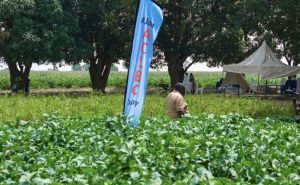
As part of the partnership, TAAT has been allocated 10 demonstration plots, each measuring 10 metres by 10 metres, at the university’s Outreach Centre. Three TAAT soybean varieties (SB-19, KENSOY 10 and EAI-3600) have been established under different treatments to provide participants with practical demonstrations of soybean performance and recommended production practices.
By the time of the trade fair, the demonstration fields will be approximately 60 days old. During guided field visits, TAAT and its partners will explain the production practices applied, the characteristics of the different varieties and the potential of soybean for local food and feed systems.
The demonstration is designed to address a key question for farmers and agricultural stakeholders in Uasin-Gishu: Can soybeans grow successfully under the county’s conditions?
TAAT’s message is clear: “There’s a TAAT for THAT.” Through the demonstration plots, the programme aims to show the potential of soybean production in Uasin-Gishu when farmers and institutions have access to appropriate varieties, production technologies and technical knowledge.
The opportunity extends beyond crop production. For a county with a strong livestock sector, locally produced soybeans could increase the availability of protein-rich feed ingredients, potentially reducing reliance on externally sourced feed inputs while creating opportunities for farmers, processors, and young entrepreneurs along the soybean value chain.
At the household level, soybeans can also contribute to improved nutrition through food products and value addition.
The partnership with the University of Eldoret is also strategic for ENABLE-TAAT, which seeks to equip young people with practical agricultural and entrepreneurial skills. With the university having significant land access but limited experience in soybean production, TAAT sees an opportunity to support students in exploring soybean-based income-generating enterprises, from production and processing to value addition.
Beyond the demonstration fields, TAAT will operate a dedicated exhibition space at the main pavilion. The space will provide an opportunity to showcase TAAT technologies, products, and services, and to engage participants in discussions on scaling agricultural innovations across Kenya and East Africa. Participants will also be introduced, in batches, to opportunities to access and scale proven agricultural technologies promoted through TAAT.
The event will therefore serve not only as a platform for demonstrating soybean technologies, but also as a space for connecting agricultural innovation with potential users, businesses, institutions and young entrepreneurs.
Through its collaboration with the University of Eldoret, KALRO and other national and private-sector partners, TAAT aims to strengthen the link between agricultural research, practical technology demonstration and market-oriented agribusiness.
According to Dr David Kolawole Ojo, Coordinator of the TAAT Soybean Compact, ” the soybean demonstration in Uasin-Gishu represents a practical step towards exploring the crop’s potential to strengthen local food and feed systems while opening new opportunities for farmers, students and young entrepreneurs in Kenya and beyond.”
Recent Stories
Related Stories
- TAAT fosters Regional Approach to Innovative Wheat Seed Enterprise Development
- Kenya: TAAT holds ToT Workshop on Soybean Agronomy, Seed Production and Entrepreneurship
- From Hoe to Hustle: TAAT underlines why Africa’s Farms Need a Youth Rebrand
- Guinea-Bissau: How TAAT is Cultivating the Next Generation of Agribusiness Leaders
- Malawi: How TAAT is Unlocking Soybean Productivity for improved human and animal nutrition