 IITA – Bénin Campus, 08 BP 0932 Tri Postal, Cotonou – République du Bénin
 @Taat_Africa
 TAAT Africa
 @taatafrica

Zimbabwe: TAAT reinforces Wheat Seed Production and Inspection capacity
As Zimbabwe seeks to increase wheat production and achieve greater self-sufficiency, improving access to high-quality seed has become a national priority.
However, many smallholder farmers still rely on farm-saved seed, often resulting in poor seed quality and lower yields.
In response to this challenge, the Technologies for African Agricultural Transformation (TAAT), through its Wheat Compact led by the International Center for Agricultural Research in the Dry Areas (ICARDA), will organise a five-day field training on seed production and seed inspection activities for farmers and agricultural stakeholders in Zimbabwe from 20 to 24 July 2026.
The training will begin with classroom sessions on 20 July, followed by practical field activities across three TAAT Seed Production Innovation Platforms.
Participants will visit the Rupike Seed Production Innovation Platform in Masvingo on 21 July, the Jombe Seed Production Innovation Platform in Mutasa on 23 July, and the Nyamubarawanda Seed Production Innovation Platform in Nyanga on 24 July, where they will receive hands-on training in wheat seed production and field inspection.
The training will bring together wheat farmers, seed growers, agricultural extension officers, researchers, seed companies, and representatives from national agricultural institutions.Access to high-quality seed remains one of the key drivers of increased wheat productivity.
However, many smallholder farmers continue to rely on farm-saved seed due to the high cost of certified seed, often resulting in declining varietal purity, reduced seed quality and lower yields.
Through this initiative, TAAT seeks to strengthen farmers’ technical capacity to produce quality seed while supporting Zimbabwe’s efforts towards greater wheat self-sufficiency.
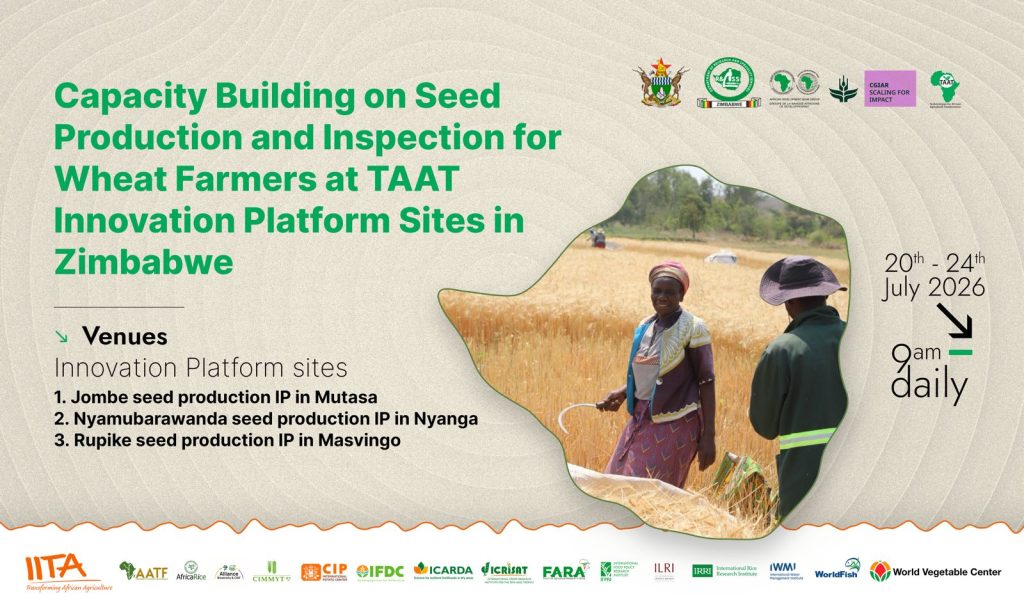
The training will combine classroom sessions with practical field demonstrations.
Participants will receive hands-on instruction on key aspects of seed production, including land preparation, variety selection, isolation requirements, rouging of off-type plants, weed management, identification of seed-borne diseases, field inspection procedures and record-keeping required for seed certification.
The programme will also highlight climate-smart wheat production practices and the management of improved wheat varieties adapted to local production systems.
Delivered in collaboration with the Crop Breeding Institute, the Seed Services Institute, the Ministry of Agriculture, Mechanisation and Water Resources Development and other national partners, the training aims to equip participants with the knowledge and practical skills needed to produce high-quality certified seed and strengthen Zimbabwe’s wheat seed value chain.
According to Dr Wuletaw Tadesse Degu, the TAAT Wheat Compact Leader, “The initiative will also reinforce the programme’s broader objective of accelerating the deployment of climate-resilient wheat technologies that enhance food security and agricultural resilience across Africa.”
“By improving farmers’ understanding of seed production standards and field inspection protocols, TAAT aspires to contribute to higher adoption of quality seed production practices, improved yields and increased availability of certified wheat seed,” he added.
Recent Stories


Related Stories
- TAAT fosters Regional Approach to Innovative Wheat Seed Enterprise Development
- TAAT Demonstrates that Food Systems Transformation and Sustainability Can Go Hand in Hand
- National Seed Business Summit begins as Zimbabwe eyes Food Systems Transformation
- Zimbabwe Hosts National Seed Summit to Accelerate Food Systems Transformation
- Zimbabwe: TAAT eyes Impact at scale with Wheat Value Chain Workshop